Common College Admissions Mistakes Families Make - And How to Avoid Them
 By Rachel Jerris
 Services
High-achieving families often enter the college admissions process with confidence. Strong grades, advanced coursework, leadership roles, and impressive test scores seem like a solid formula for success. Yet outcomes today can feel surprisingly inconsistent. Students with exceptional profiles face waitlists or rejections, while peers with similar credentials see different results. This disconnect creates frustration and confusion, especially for families who believe they did everything right.
The reality is that college admissions has changed in ways many families underestimate. Test-optional policies, holistic review, and shifting institutional priorities have reshaped how applications are evaluated. Relying on outdated assumptions can quietly undermine even the strongest profiles.
Empowerly helps families avoid these common missteps by combining expert admissions guidance with data-driven tools, giving parents and students a clearer, personalized strategy for their major that reflects how decisions are actually made today.
Mistake #1: Overestimating the Power of Perfect Grades and Test Scores
The Myth of Academic Guarantees

Why top grades and high test scores no longer ensure admission
-
Many selective colleges have reduced their reliance on standardized tests after the widespread adoption of test-optional policies.
-
Even at schools that still consider test scores, admissions leaders stress that scores represent only one part of a much broader evaluation.
-
Test-optional admissions pushed colleges to rely more on alternative measures of academic readiness and holistic review.
-
With record application volumes, thousands of students now apply with near-perfect GPAs and strong scores, making academic excellence a baseline rather than a distinguishing factor.
How holistic review evaluates context, rigor, and personal qualities
-
Holistic admissions uses contextual review to evaluate achievements relative to a student’s school environment and available opportunities.
-
Colleges assess course rigor alongside grades, paying close attention to whether students challenged themselves with advanced options such as honors, AP, or IB classes.
-
Personal qualities like resilience, curiosity, leadership, and initiative now play a larger role in admissions decisions.
-
This approach allows students from diverse backgrounds to stand out in ways grades and scores alone cannot capture.
Empowerly helps families understand how academics are actually evaluated today and ensures students present their achievements in the right context.
What Families Should Do Instead

BOOK FREE CONSULTATION
Focus on the academic narrative, not just numbers
-
Admissions officers look for a coherent academic story that explains what a student cares about and how their interests developed over time.
-
Colleges want to understand intellectual identity, including curiosity, initiative, and engagement beyond required coursework.
Understand how course rigor and trends matter
-
Admissions teams increasingly rely on course rigor and grade trends when test scores are optional or not submitted.
-
Upward academic trends and a willingness to take on more challenging coursework can strengthen an application, even without perfect grades.
-
Rigor is always evaluated in context, based on what a student’s school actually offers.
Empowerly guides students in shaping a clear academic narrative and making strategic course choices that align with how selective colleges review applications.
Mistake #2: Building a “Well-Rounded” Profile Instead of a “Spiky” One

Why “Well-Rounded” Is Outdated
Colleges seek well-rounded classes, not well-rounded individuals
-
Many families believe students should join as many clubs and activities as possible to appear “well-rounded.” In practice, this often dilutes impact and makes profiles blend together.
-
Selective colleges increasingly prefer applicants who show focused passion and meaningful achievement in one to three areas rather than surface-level involvement across many.
-
The idea of the “perfect well-rounded student” with endless leadership roles and activities is outdated. Admissions teams now look for genuine interest, initiative, and follow-through.
The rise of the “spike”: depth over breadth
-
A “spike” reflects exceptional depth in a specific area, whether academic, artistic, athletic, service-oriented, or entrepreneurial.
-
Admissions officers can quickly spot resume padding and instead value authentic commitment and measurable impact.
-
Focused involvement helps admissions teams understand a student’s identity, motivation, and potential contributions more clearly than a scattered activity list.
-
Depth demonstrates growth, skill development, and sustained passion over time.
Empowerly helps students identify and develop strong spikes that align with their interests and with what selective colleges actually value.
How to Avoid This Mistake

BOOK FREE CONSULTATION
Encourage meaningful, sustained interests
-
Students should pursue activities they genuinely care about, not those chosen solely for appearances.
-
Long-term involvement shows commitment, leadership, and initiative, all of which carry significant weight in holistic admissions.
-
Extracurricular depth can be just as influential as academics when it demonstrates real engagement and impact.
What depth looks like in extracurriculars
Depth can take many forms, including:
-
STEM-focused involvement:
-
Independent research projects
-
National or regional science competitions
-
Building apps, tools, or engineering solutions
-
Leadership in robotics or coding teams
-
Humanities-focused involvement:
-
Publishing writing or journalism
-
Competitive debate or Model UN leadership
-
Creating literacy or education programs
-
Arts-focused involvement:
-
Developing a portfolio with performances or exhibitions
-
Composing music or producing films
-
Recognition in regional or national competitions
-
Service or leadership-focused involvement:
-
Founding or scaling a community initiative
-
Leading long-term volunteer projects with measurable outcomes
-
Advocacy through education, outreach, or policy work
-
Entrepreneurship-focused involvement:
-
Launching a business or startup
-
Developing products with real users
-
Demonstrating growth, revenue, or community reach
Empowerly guides students in building depth-driven extracurricular strategies that feel authentic, sustainable, and compelling to admissions officers.
Mistake #3: Treating Essays as a Writing Assignment Instead of a Personal Narrative

What Families Misunderstand About Essays
Essays are not about accomplishments—they’re about character
-
College essays are one of the few places where admissions officers learn about a student’s personality, values, and motivations, not just achievements.
-
The purpose of the essay is to show authentic voice, not to repeat the résumé or list accomplishments already found elsewhere in the application.
-
Strong essays reveal personal perspective, growth, and insight, helping admissions officers understand how a student thinks and what matters to them.
Common pitfalls: over-editing, parental voice, generic topics
-
When parents take over shaping the essay, the student’s authentic voice often disappears.
-
Over-editing can make essays sound polished but impersonal, stripping away individuality.
-
Many students choose generic or overused topics that lack personal reflection, making essays blend together.
-
Admissions officers focus less on what happened and more on how the experience changed the student’s perspective or behavior.
Empowerly helps families understand what admissions officers actually look for in essays and why authenticity matters more than perfection.
How to Avoid This Mistake

BOOK FREE CONSULTATION
Encourage reflection and authenticity
-
Strong essays come from meaningful reflection on identity, values, and growth.
-
Topics should allow room for vulnerability, insight, and personal perspective rather than surface-level storytelling.
Give students space to develop their own voice
-
Students need time and independence to brainstorm, draft, and revise without adults rewriting their work.
-
The most compelling essays sound unmistakably like the student, not a parent or professional editor.
-
Colleges value distinctive perspectives and thoughtful reflection over flawless writing.
How Empowerly supports essay development
-
Empowerly’s essay coaching focuses on uncovering a student’s real story rather than manufacturing one.
-
Coaches guide students through:
-
Brainstorming meaningful topics
-
Identifying personal themes that show character and growth
-
Structuring narratives around insight, not events
-
Preserving the student’s voice while strengthening clarity and impact
Empowerly’s essay coaches help students craft narratives that feel honest, thoughtful, and memorable—without losing the voice admissions officers want to hear.
Mistake #4: Starting Too Late

Why Timing Matters
Admissions is cumulative, not last-minute
-
College admissions is shaped by choices students make across all four years of high school, not just senior year.
-
Early planning helps students build a strong foundation in academics, extracurriculars, and personal growth.
-
Sustained activities and leadership roles take time to develop and carry far more weight than last-minute involvement.
-
Strong relationships with teachers, which lead to meaningful recommendation letters, are built gradually through consistent engagement.
The cost of last-minute planning

-
Junior and senior years are already academically demanding, and rushing the admissions process adds unnecessary pressure.
-
Students who start late often miss:
-
Leadership opportunities
-
Competitive summer programs
-
Time to build extracurricular depth
-
Strategic testing plans
-
Space for thoughtful essay development
-
-
Late planning often leads to rushed essays, weaker applications, and higher stress for both students and parents.
Empowerly helps families understand why timing matters and builds long-term admissions strategies that start early and reduce last-minute pressure.
Mistake #5: Overloading Students With Activities

The Misconception That “More Is Better”
Why admissions officers prefer impact over quantity
-
Admissions officers consistently emphasize that depth matters more than breadth. A long list of activities often signals overextension rather than meaningful engagement.
-
Colleges look for impact, leadership, and sustained commitment, not participation in every available club.
-
Overscheduling has become common as families feel pressure to keep students constantly busy, but this often leads to shallow involvement instead of genuine passion.
-
Selective colleges prefer students who demonstrate authentic interest and initiative in a few areas rather than surface-level participation across many.
The burnout risk for high-achieving teens
-
Burnout among teens is rising due to academic pressure, extracurricular overload, and admissions-related stress.
-
High-achieving students often juggle advanced coursework, test preparation, leadership roles, and multiple commitments at once.
-
This constant pressure can lead to physical exhaustion, emotional fatigue, anxiety, and loss of motivation.
-
When students are overwhelmed, both well-being and application quality tend to suffer.
Empowerly helps families recognize when “doing more” starts to work against students and guides them toward balanced, high-impact involvement that admissions officers value.
How to Avoid This Mistake
Prioritize meaningful commitments
-
Families should encourage students to focus on one to three core interests rather than trying to do everything.
-
Meaningful commitments allow students to develop:
-
Leadership
-
Expertise
-
Long-term impact
-
Personal growth
-
Reducing overload creates space for reflection, creativity, and deeper engagement, which colleges increasingly look for.
Choose activities aligned with interests and goals

-
Students should select activities that align with their genuine interests, strengths, and long-term goals, not activities chosen solely to impress.
-
When students care about what they’re doing, they are more likely to:
-
Stay involved over multiple years
-
Take on leadership roles
-
Produce meaningful outcomes
-
Maintain a healthier balance and avoid burnout
-
Empowerly helps students design extracurricular strategies that balance ambition with well-being, ensuring activities feel purposeful, sustainable, and compelling in holistic admissions.
Mistake #6: Ignoring Institutional Priorities

What Families Often Overlook
Majors in demand, geography, first-generation status, and yield protection
-
Majors in demand: Colleges adjust admissions based on program capacity and institutional needs. Oversubscribed majors such as engineering, computer science, and business often have much lower admit rates because seats and faculty resources are limited.
-
Geographic diversity: Colleges aim to enroll students from a wide range of regions. Applicants from heavily represented states or countries may face tougher competition, while students from underrepresented areas may receive added consideration.
-
First-generation and underrepresented students: Many institutions prioritize first-generation, low-income, and historically underrepresented students as part of their mission and long-term goals. These priorities can influence outcomes even among academically similar applicants.
-
Yield protection: Some colleges waitlist or deny highly qualified students they believe are unlikely to enroll. Schools use engagement signals and predictive modeling to manage enrollment targets, rankings, and budgets.
Why strong applicants get rejected for reasons unrelated to merit
-
Admissions decisions are shaped by institutional needs, not just individual achievement.
-
Even highly qualified students may be denied because:
-
Their intended major has reached capacity
-
Their region is overrepresented
-
The school needs to meet diversity or mission-driven goals
-
Data suggests they are unlikely to enroll
-
These factors explain why strong students sometimes face unexpected outcomes despite impressive profiles.
Empowerly helps families uncover the hidden institutional factors influencing admissions decisions and understand why outcomes are not always tied directly to merit.
How to Avoid This Mistake

BOOK FREE CONSULTATION
Build a balanced and strategic college list
-
A strong college list includes reach, match, and likely schools based on both academic fit and institutional priorities.
-
Families should avoid relying only on rankings or name recognition, as schools vary widely in selectivity by major and applicant pool.
-
Understanding enrollment strategy helps students avoid concentrating applications in oversubscribed programs or yield-sensitive schools.
Understand how different colleges evaluate applicants
-
Colleges differ significantly in how they weigh academics, essays, extracurriculars, and institutional needs.
-
Some institutions rely heavily on data and predictive modeling.
-
Others emphasize mission-driven goals such as geographic balance, first-generation access, or community impact.
-
Researching each school’s admissions approach allows families to set realistic expectations and tailor applications effectively.
Empowerly helps families build smarter college lists and application strategies by aligning student profiles with how individual colleges actually make admissions decisions.
Mistake #7: Misunderstanding Test-Optional Policies

What Families Get Wrong
Believing test-optional means tests don’t matter
-
Many families assume that “test-optional” means colleges no longer consider test scores at all. In reality, most colleges still review scores when they are submitted.
-
Test-optional policies expanded rapidly during the pandemic, but many institutions continue to use scores as one of several tools to evaluate academic readiness.
-
Colleges now rely on alternative academic indicators alongside grades, coursework, and context, especially when scores are not submitted.
-
Because institutions differ in mission and priorities, test-optional policies are applied differently from school to school.
When scores help—and when they don’t
-
Submitting strong scores can help when:
-
Scores are above a college’s typical admitted range
-
A student attends a school with grade inflation or limited rigor
-
The student applies to quantitative majors such as engineering, computer science, or business
-
Scores may not help when:
-
They fall below the school’s usual range
-
Academic rigor, grades, and activities already demonstrate readiness
-
The institution’s test-optional approach strongly de-emphasizes testing in favor of equity goals
Empowerly helps families understand what test-optional really means at different colleges and why assumptions about testing can quietly hurt strong applications.
How to Avoid This Mistake

BOOK FREE CONSULTATION
Evaluate score submission strategically
-
Families should base test-submission decisions on data, not anxiety or peer pressure.
-
Each college weighs test scores differently, which means there is no universal right answer.
-
Making school-specific decisions helps students avoid submitting scores that weaken an otherwise strong application.
How Empowerly supports informed testing decisions
-
Empowerly uses data-driven tools, including the Empowerly Score®, to assess a student’s competitiveness at specific colleges.
-
Counselors help families understand:
-
College-specific testing policies
-
How scores interact with GPA, rigor, and extracurriculars
-
When submitting scores strengthens an application and when it does not
-
This guidance ensures decisions are grounded in evidence and aligned with each school’s admissions philosophy.
Empowerly gives families clarity around the test-optional strategy so students can submit applications with confidence, not second-guessing.
Mistake #8: Focusing Only on Prestige Instead of Fit

The Prestige Trap
Why chasing brand-name schools leads to disappointment
-
Many families overestimate the long-term value of attending a highly selective, brand-name college, assuming prestige guarantees success.
-
Record-high application numbers at selective schools have driven admit rates even lower, making outcomes more unpredictable than ever.
-
Even top students now face frequent rejections simply due to volume, not lack of qualification.
-
A prestige-first strategy often ignores how competitive the landscape has become and overlooks excellent colleges where students may thrive academically and personally.
Why fit matters more than selectivity

-
Students are more likely to succeed at colleges aligned with their learning style, academic interests, and campus culture.
-
Research consistently shows that engagement, mentorship, well-being, and long-term satisfaction are stronger at schools where students feel supported and connected.
-
As admissions policies and institutional priorities continue to shift, choosing a school based on fit rather than reputation alone has become increasingly important.
Empowerly helps families move beyond prestige-driven thinking by identifying colleges where students are most likely to thrive and succeed.
How to Avoid This Mistake
Use structured criteria to evaluate colleges
Families can make better decisions by evaluating schools across multiple dimensions, including:
-
Academic fit: majors, curriculum structure, research opportunities
-
Social fit: campus culture, diversity, student organizations
-
Emotional fit: advising quality, mental health resources, support systems
-
Financial fit: affordability, scholarships, long-term value
-
Career fit: internships, alumni networks, job placement outcomes
Looking beyond rankings allows families to make informed choices grounded in what actually supports student success.
Build a list that reflects the student’s strengths and goals
-
Strong college lists are built around where students will thrive, not where they feel pressure to apply.
-
Aligning applications with authentic strengths, interests, and long-term goals leads to better outcomes and less stress.
-
A balanced list reduces emotional strain and increases the likelihood of multiple strong options in an unpredictable admissions year.
Empowerly helps families build thoughtful, balanced college lists that prioritize fit, confidence, and long-term success over name recognition.
How Empowerly Supports Students at Every Step of Admissions
One-on-One College Counseling

Empowerly offers personalized, one-on-one college counseling with experienced admissions experts, some of whom have previously worked as admission officers. These sessions focus on understanding each student’s academic profile, interests, and goals. Counselors guide families through planning, positioning, and application strategy, helping students make informed decisions instead of guessing their way through an increasingly complex admissions process.
Essay Support


Empowerly’s essay support helps students move beyond generic writing. Advisors assist with brainstorming meaningful topics, shaping clear narratives, and refining drafts without losing the student’s authentic voice. The focus stays on clarity, insight, and impact, ensuring essays communicate who the student truly is rather than sounding rehearsed or over-edited.
Extracurricular Guidance and Project Support

Empowerly helps students evaluate their activities and identify where deeper engagement matters most. Counselors guide students in strengthening involvement, pursuing leadership, and developing passion-driven projects. This support encourages focus and purpose, helping students build extracurricular profiles that show growth, initiative, and real impact over time.
Empowerly Score®
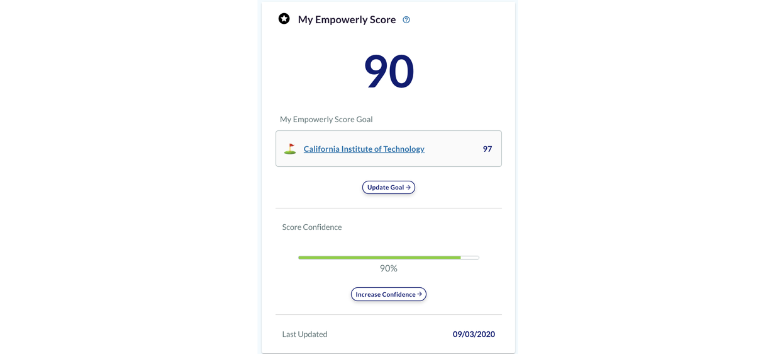
The Empowerly Score® is a proprietary assessment designed to evaluate a student’s admissions competitiveness. By analyzing academics, activities, and other key factors, the score helps families understand strengths and gaps. It provides a clearer picture of where a student stands and what areas may need strategic improvement.
Application Planning and Timeline Management

Empowerly supports families with structured application planning and timeline management. Students receive guidance on deadlines, requirements, and task sequencing. This approach reduces last-minute stress, keeps applications organized, and helps students stay ahead of key milestones throughout junior and senior year.
College List Support
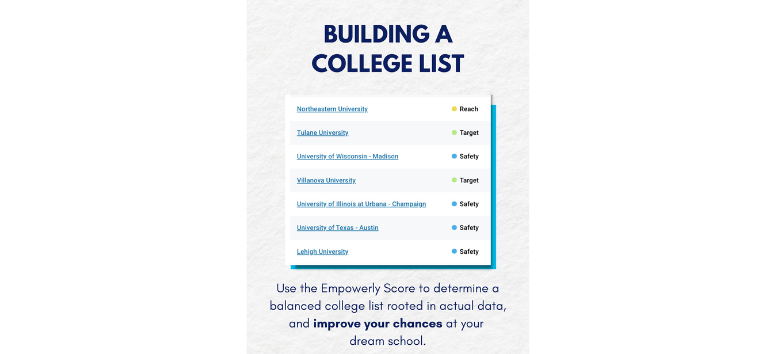
Empowerly assists students in building thoughtful college lists aligned with academic interests, personal preferences, and long-term goals. Counselors help balance reach, match, and likely schools while considering institutional priorities. This support helps families avoid overreliance on rankings and focus on realistic, well-matched options.
Interview Preparation

Empowerly provides interview preparation to help students feel confident and articulate. Through practice sessions and feedback, students learn how to present themselves clearly, reflect on their experiences, and respond thoughtfully. This preparation helps interviews feel conversational and authentic rather than intimidating or scripted.
Specialized Guidance

Empowerly offers specialized guidance tailored to specific pathways such as STEM, research, arts portfolios, and entrepreneurship. This targeted support helps students align coursework, projects, and applications with their intended direction, ensuring their profile reflects both interest and preparation in competitive or niche fields.
Avoiding common admissions mistakes starts with having the right guidance early. Empowerly helps families spot missteps before they become missed opportunities and replace guesswork with informed strategy. Work with experts who understand where applications go wrong and how to position your student for stronger, more confident outcomes.
College admissions mistakes often stem from outdated beliefs, not a lack of effort. By understanding how the process truly works today, families can avoid common missteps and make smarter decisions earlier. With expert guidance from Empowerly, students gain clarity, confidence, and a strategy that reflects real admissions expectations.